Showing posts with label between keyboard and chair. Show all posts

Sunday, August 28, 2011

Historical Miniature War Gaming

It's been a hot summer and I must admit to essentially taking it off from blogging or doing anything else work related on the 'Net. However, the time has come again to start writing for Between Keyboard and Chair.

In July I happened to be in Smiths Falls, Ontario and dropped by Monolith Architectural Models to visit my nephew, Noel White. For as long as I can remember, Noel has been entranced by historical miniature war gaming. It was a quiet day at Monlith and Noel was busy working on some of his models. I took one look and decided that he should guest author a blog article. So I now turn you over to Noel:


Miniature War Gaming


I was invited by Don White to write a short article for Between Keyboard and Chair on one of my hobbies - historical miniature war gaming. It's something I've enjoyed for at least 20 years, and I've found it a rewarding and relaxing hobby. Though my father had a small collection of miniature soldiers, it didn't really begin until a good friend and neighbour gave me a sci-fi figure and encouraged me to paint it. My first paint job was sloppy and crude, but I enjoyed it enough to purchase some of my own. I then discovered the various games that one could play with enough miniatures and a willing opponent. As a young teenager I was drawn to the fantasy and sci-fi variety but over the years I lost interest in fiction and moved on to historical games and miniatures. After all, anyone could invent fiction. I felt using my own imagination and doing my own research was far more rewarding than memorizing fantasy.


Just What Is It?


So what is historical miniature war gaming? Its usually 2 players, each with a collection of miniatures representing an army from a particular period in history. They are placed on a large table that is often decorated with simulated ground features (what we call “terrain”) and moved with the use of rulers or other templates. Dice are rolled to simulate the unpredictable factors of combat, and ultimately determine who wins and who loses. Often you'll receive advantages to your dice rolls if you can catch the enemy in unfavourable circumstances. For example, pikemen may enjoy an advantage versus cavalry, or the enemy may suffer if you attack him from behind. A complete game (or “battle”) can take anywhere from a few hours to a few days based on the set of rules you have agreed to use. My current favourite set of rules for ancient/medieval warfare simulation is Field of Glory, published in the UK, and it sits somewhere in the middle in terms of complexity and provides a reasonable degree of historical accuracy. A Field of Glory battle is usually over in 3-4 hours. Those who are interested can compete in tournaments at some of the larger gaming conventions.


Model Making and Research


Gaming aside, my favourite part of the hobby is the model-making and research. Within the restrictions of your chosen set of rules, you build an army of little soldiers that resemble its historical counterpart. There is lots of variety in scale and new manufacturers are emerging every year. The pewter or lead figurines are usually mail-ordered from a web-store, since few conventional retailers exist in Canada. You assemble and paint them yourself, after having researched the appropriate colours and battle formations in the translations of various ancient texts and excellent modern accounts. You can easily spend as much time reading as painting! You can also find tips and painting techniques that really bring the figures to life and make the tiny details much easier to handle. It can take many, many hours to put together an army of 100-200 figures and a great deal of time and patience is involved. You are also encouraged to make the terrain your army will fight across (such as villages, hills, forests, rivers and so on) as well as a suitably decorated game-table.


From Hobby To Career


This unusual hobby of mine has lead to other things including my unusual career! I operate my own a scale model-making business near Ottawa called Monolith Architectural Models. The majority of my clients are architects and real estate developers who need high quality scale models for sales offices and presentations. In a way, I turned my hobby into my business. I'm also considering a second business fabricating components and terrain for various war games, and possibly developing my own game.


I'm also involved in a play-testing group for Field of Glory version 2. We are all volunteers from all over the world testing the latest suggestions to improve the game. We record our battles and submit the results to the design team who make adjustments accordingly. There is lots of debate and research involved too!


I encourage any who are interested to seek out their local hobby club and ask some questions. It's a very rewarding pastime with plenty of opportunity for socializing, learning and fun.

Noel White,
Monolith Architectural Models
1+613-205-1071

Monday, June 13, 2011

Don White Photography

After years and years of shooting photographs I've decided to try marketing some of them online. Granted, I've sold matted and framed photos locally but that has been as a result of word-of-mouth, so I've decided to see what the Internet can do for me. The site I've set up is Don White Photography. I also have accounts at Artist Websites and RedBubble. Photographs, cards, T-shirts and stickers can be purchased at these locations.

Art Prints

Art Prints

Buy art


Feel free to drop by Don White Photography or go directly to my accounts at Artist Websites and RedBubble.

If nothing else, I hope I bring some enjoyment to you with my pictures.

That's the way I see it from Between Keyboard and Chair

Don

Saturday, March 5, 2011

Government of Canada Overthrown

Nothing raises the blood pressure more at Between Keyboard and Chair than the arrogance of little Stevie Harper and his drones. King Stevie and the PMO have decided there no longer is a Government of Canada.  Instead it's been replaced in government pronouncements by the HARPER GOVERNMENT.


Now this has been going on for quite some time but King Stevie has become more arrogant since the beginning of 2011. I did a search of the Government of Canada web site for the phrase "harper government" and the following numbers show the major increase in the use of Harper Government in departmental pronouncements since the beginning of the year.
  • 2011 (128)
  • 2010 (60)
  • 2009 (44)
  • 2008 (9)
  • 2007 (1)
  • 2002 (3)
This is just another example of King Stevie's contempt for the People of Canada and further exemplifies his goal of turn Canada in to Steven Harper's Canada.

At least that's how I see it from Between Keyboard and Chair.

Y'all come back now, eh?

Don

Thursday, February 3, 2011

Walter Cameron's 75th Birthday Party

Walter and partner, Marlyn
On Saturday, January 29, I had the pleasure of attending the 75th Birthday Party for Walter Cameron in Almonte at the home of  his daughter, Wanda, and her partner, Rob. I also had the pleasure, at the invitation of Wanda, of being the MC during the sit-down meal. There had to be at least 40 people in attendance and many of them were accomplished musicians that Walter has played with over the years. Needless to say, the evening ended up with a lot of good music being played until we finally shut down around midnight. An excellent way to pass a Saturday night.

One nice touch to the evening was the presence of four generations: Walter, his daughter Wanda, grand-daughter Amanda, and great-grandson Dallas.

Wanda, Walter, Dallas and Amanda
I've known Walter for almost as long as I can remember. In fact the first time we ever met we attended a dance together in Canonto, Ontario.  Apparently, Walter wasn't too impressed with my vocal capabilities at that event. However, I was only about 18 months old at the time and he had to look after me while my parents and his older sister were up dancing. He was somewhat underwhelmed that he had to entertain a squalling kid.

Walter in 1961
We lost touch with one another after that inauspicious start to our friendship and we didn't really connect again until 1960 when Walter joined the Mississippi River Boys as a vocalist and guitar player. The Mississippi River Boys was a country dance band that played throughout Lanark, Renfrew, Frontenac and Carleton counties in Eastern Ontario from 1956 to 1985.  I had been playing with the band since New Years Eve 1958. Walter and worked together from 1960 until 1977 when he left to play with the late Ron McMunn.  Since then we've run into one another at various events but as we've gotten older those meetups have become all too infrequent.  About three years ago we had the good fortune to have Walter sit in with Grateful We're Not Dead at a show we were doing at a Western Games event at Drummond Center. Maybe we can arrange for him to make another guest appearance.

As I mentioned, there were a large number of talented musicians at Walter's party and everyone had a chance to perform. Of course, the night would not have been complete without getting Walter up to the mic and he finished off the entertainment for the evening.  I had my iPod Touch with me and was able to catch him on video.


Performing with Walter are Ray Donaldson - peddle steel, Mac Knowles - lead, Wayne Munroe - drums, and Tom Gardiner - bass.

So Walter, I expect to be invited to your 80th, 85th, 90th and 95th birthday parties. And if you make 100, I'll see to it that Grateful We're Not Dead is there to entertain you.

And a final insight garnered at the party: As young bucks, all the guitar players I knew had belt buckle scratches on the back of their guitars. As I looked around the room on Saturday night, I realized that none of us has to worry about scratching the back of our guitar anymore.  There's a lot more padding now.

At least that's how I see it from Between Keyboard and Chair.

Don

Friday, January 21, 2011

Fifty Six Seconds

Well I'll be damned!!! It's amazing how things eventually connect together. Recently, from my position Between Keyboard and Chair I came across an article that states:
"FIFTY SIX SECONDS is all the time a person will spend watching your loading animation, clicking through your site, reading your copy, and watching your content. A 60-second spot."
This article was posted in 2009 on Annoying Design.

Back in 2006 I read an article in the Ottawa Citizen which quoted a study that had shown:
"women think of sex once every two weeks whereas men think of sex every 58 seconds"
and as a result, in 2007 I wrote a song for Grateful We're Not Dead entitled At Least Once Every Minute.

Needless to say, it's likely the men surfing the 'Net who have had the greatest impact in generating the 56 second statistic. It then allows them 2 seconds to switch over into thinking about sex.

At least that's how I see it from Between Keyboard and Chair.

Don

Saturday, August 7, 2010

Good Bye, Mr Kitty

It is with sadness and a sense of loss that I sit Between Keyboard and Chair writing these words. I feel as if I've lost a good friend.

Mr Kitty


Mr Kitty was a cat. He wasn't my cat. He was a neighbour's cat. Or more accurately, he was the neighbourhood's cat.

Mr Kitty came into our lives when his owner, Frank, rescued him when his mother had abandoned him. Frank fed the kitten from an eyedropper every few hours and Mr Kitty survived to become a beloved character amongst most of the neighbours.

The Young Mr Kitty
The young Mr Kitty

The Alpha Cat


Mr Kitty was neutered and de-clawed but he was very much the Alpha Cat at our end of Ariel Court. Other cats knew to keep their distance when Mr Kitty was making the rounds of his domain and if they didn't show the proper respect they were quickly brought into line. He certainly knew how to use his teeth and his back claws.

The Food Circuit


Mr Kitty knew exactly where to go on the Court to get fed. He made his rounds to all the accommodating houses every day. At 5:00 AM he would be on our kitchen window sill waiting for his breakfast. He'd return a few times a day for a snack. If you didn't notice him or didn't pay attention to him he'd stand on his back legs and paw against the screen until you fed him. Anytime our van turned onto the Court, we'd likely see Mr Kitty making a beeline for our doorstep to greet us. At those times he likely wasn't hungry, he was just dropping by to get his head scratched.

King of the Court


When it came to petting him, you had to show the proper respect. If he felt you were getting too familiar he'd quickly warn you with a little nip on the fingers. After all he was the King of The Court. He was quite picky about his friends. If you were his friend, he'd rub up against your legs and let you pet him lightly. If you weren't his friend, then beware. He wasn't adverse to giving you a little nip just to show you your position in the pecking order.

A Fatal Weakness


Mr Kitty had a fatal weakness. He wasn't afraid of cars. He would sleep on, in or under vehicles. If you left a car window open you would likely find Mr Kitty sleeping in the car. If he was lying on the hood or roof, he wouldn't move even when you started the vehicle. He once spent two days locked in the trunk of a car because he had crawled in and gone to sleep. He was found when the owner took the car to a garage for maintenance. That attitude can be deadly and unfortunately, fate caught up with Mr. Kitty a week ago. He was lying under a vehicle and was accidentally run over. His injuries were too severe and he had to be euthanized the following day.

Mr Kitty on Arpil 23, 1010
Mr Kitty on April 23, 2010

During the years Mr Kitty was with us, he became a habit for us. First thing in the morning we'd put cat food out on the window sill for him. If we saw him coming across the walk between the houses we'd go to the door to greet him. He certainly had trained his subjects well over the years and we all had learned to show him the proper respect for one in his position.

Bless you Mr Kitty. You are sorely missed.

At least that's how I see it from Between Keyboard and Chair.

Don

Tuesday, July 6, 2010

Plurk And Me

Back in September of 2008 I wrote a guest blog on a website that has since changed it's focus. After a bit of creative searching I managed to track down the article and have brought it home to Between Keyboard And Chair. So after some minor changes and with no further ado here is Plurk And Me

I assume if you’re reading this article you may already know about Plurk. If not, there are plenty of other articles online that will explain Plurk. As for the “me” in the title, I’m a 67 year old, retired Public Servant, Linux advocate, computer aficionado, avid Internet user, social networking junkie, photographer and musician (see Grateful We're Not Dead) - all of which I engage in with varying degrees of success. But the only thing I intend to talk about today is social networking: Plurk and me.
I originally became involved with computers in 1978 when I purchased a Commodore PET 2001. By the early 1980s I had my first exposure to what could be called “early social networking” via Bulletin Board Systems (BBS) and I actually ran a BBS out of my home for a number of years. By the early-90s Internet access had become available at home and I started using email and Internet Relay Chat (IRC) to communicate with people.
Then along came ICQ in the mid-90s and I started to connect with people world wide. I used various Instant Messaging Services until 2007 when I was introduced to the social networking / micro-blogging service, Twitter, during Ed Dale’s Thirty Day Challenge. I started using Twitter on a regular basis meeting more and more people around the globe. One of these, Allan Cockerill, a friend in Australia, introduced me to Plurk in June 2008.
Once I saw Plurk’s horizontal, scrollable timeline of time stamped messages (Plurks) along with the drop-down window containing all responses to the Plurk, I was hooked.
Plurk has become my main means of communicating within the social networking milieu mainly because of the ease with which I can track ongoing conversations (Plurks and responses). I quickly came to realize that Twitter was good for making announcement but Plurk had put the “social” back in social networking. I build my network of connections (friends) by checking the timelines of those who have responded to a Plurk, if I have not encountered them before. If the content of their timeline looks interesting I will either add them as a friend (once they have agreed to the request) or simply follow their Plurks. And in turn, I receive friendship requests from Plurkers who have come across me in a similar manner.
The one thing I find within Plurk is a sense of community that quickly builds up amongst the users. You can quickly become emotionally involved with the successes and failures, the joy and the sorrow of these on-line friends. If they disappear for a number of days you begin to worry about them and make inquiries of common friends. If they have a birthday, get a new job, have a baby, get married, etc., you celebrate with them. If they feel down you try to raise their spirits. As in any relationship, occasionally there are disagreements and arguments but as in most friendships these are usually resolved in an amicable manner.
As my group of friends has grown it has become virtually impossible to respond to every Plurk that appears on my timeline. However, there is a core group that I normally converse with, however briefly, each day. I then scan the timeline looking for interesting Plurks for which I may have a response. After that, I must confess, the remainder get MAAR’ed (Mark All As Read). But I do try to respond to every active friend at least once or twice a week.
Will I continue to use Plurk in the foreseeable future? I believe so, simply because of the emotional connections that have developed in this community of users. These are people I would miss if I didn’t hear from them occasionally. These “digital world” friends do not replace those in my “analogue world” but strongly supplement them.
I imagine I’ll continue to build my network of friends and acquaintances for quite awhile to come. And hopefully, if you’re interested, I’ll meet you in Plurk as well.
And if you want to link up with me on Plurk you'l find me at http://www.plurk.com/user/donwhite

Friday, June 25, 2010

You Can't Throw That Out!

Having lived in our home for almost 39 years, Helen and I have accumulated quite a bit of what would be considered by some to be junk. Now granted, it's all good junk but occasionally we get the urge to free up some space by passing on some of this excellent material to others. Of course, when that decision is made then comes the problem of deciding what we really, really need to keep and what we can gift to our friends, relatives, neighbours or whomever. Needless to say, as this task proceeds the keep pile always stays larger than the give pile.

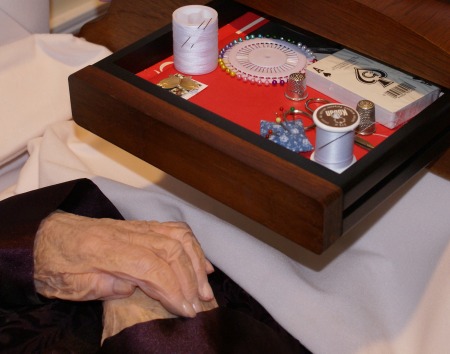
However, the one area that is sacrosanct is Helen's stash. Anytime I look towards any of it, her immediate response is, "You can't throw that out!". Now when I was 40 years younger stash meant a whole different thing to me than it does now. Today's stash doesn't cause shivers down your back every time you see a police car cruise down the street. Of course, I'm talking about the fabric stash, that continually increasing collection of fabrics used for quilting. Helen is one of those quilters who keeps every little remnant of fabric just in case there might be a need for it. All of this material is stored in see-through plastic bins somewhat sorted by type of material and colour.

Part of the Stash

Now I thought it was getting a bit much awhile ago when I came across a bag of fabric scraps that were at least 40 years old. She said her mother had given them to her a few years ago and some of them were left-overs from quilts an aunt, long deceased, had made. My immediate response was, "What in Hell do you need 40 year old scraps for?". But being a well trained husband I didn't touch that bag.

Typical condition of frayed logs.

Well I've been put in my place. A few days ago, Helen started restoring a 50 year old Log Cabin quilt that belongs to one of her sisters. The quilt had been a gift from the same aunt whose scraps are in that bag in the basement. And guess what - some of that material is the same as was used in the quilt! So as part of the restoration, some of the original fabric will be used. A nice touch!

Original green fabric used in restoration.

So this old quilting-widower knows that when She Who Must Be Obeyed says, "You can't throw that out!", then I don't touch it no matter what it is, because her intuition is telling her that it will be needed in the future.

At least that's the way I see it from Between Keyboard and Chair.

Have a good one,

Don

Thursday, April 8, 2010

The Hands of the Quilter Stilled

I've been away from Between Keyboard and Chair for six months. It's amazing how time flies, even when you're not having fun.

My mother-in-law, Edna Gertrude Ireton (nee Gardiner) passed away on February 10, 2010 in her 93rd year. Edna had spent the last 15 years in a wheelchair as the result of a stroke which had left her paralyzed on the left side. Up until the Fall of 2008 when she moved to Lanark Lodge in Perth, Ontario she had lived in her own home near Drummond Centre with the assistance her son, Bob, who lived with her and home care workers who came to the house both morning and evening.

Edna was raised in the country, married in the country, raised her children (Helen, Allan, Bob, Barbara, Beverly, Dianne and John) in the country, lived her whole life in the country. In 2008, at the prompting of a daughter-in-law, she wrote some short notes concerning her life. I'd like to include a couple of them here.

First some comments concerning her youth:
"As a young girl I had a good sense of humour. Quiet. We didn't have much in the line of entertainment. We learned to play cards young. Sometimes some of us would gather at someone's house. If we were lucky we had live music, a violin, a tin whistle. We learned to dance. My father and two of my brothers were good step dancers.

I had three brothers older than myself, one sister younger. I never went to school after Grade 8. Back then it was Senior 4th Grade. My sister went to high school, then to business college. Got a job bookkeeping for a local business. I stayed at home, helped my mother. Money was scarce. You learned to save your pennies until you had enough to buy whatever you wanted or needed. You helped your neighbours when needed. Didn't always get paid. We didn't have the opportunities that the young people have today. I was 25 yrs old when I married in May 1942."
And what it was like being a farmer's wife:
"A typical day for me in my early married life would be to get up in early morning and help milk the cows by hand, feed calves and the hens or chickens before breakfast. There was a baby to look after, feed and dress. Washing to be done.

Had to have a noon meal ready the included potatoes and meat. Back then in the 1940s it was salt pork. It was stored in a salt brine in the basement. You had to dig a piece out, slice it by hand, parboil it in milk and water, then fry the slices. It tasted good enough. A lot of work. You had to have desert, pudding, pie or cake. Supper was much the same.

In the summer time there was always extra, the garden. Men had the crops and hay. Women were often called upon to help. It was busy and tiresome. Not much money. I guess when you're young you can handle these things better. It was the way of life."

Edna's passion was quilting and even after suffering her stroke and having the use of only one hand she continued to quilt with the help of two of her daughters, Helen and Barbara, and some of her quilting friends. All her children, grandchildren and some of her great-grandchildren received at least one of Edna's quilts during her lifetime.


Edna's Quilts - 1

Edna's Quilts - 2

Edna's Quilts - 4

Edna's Quilts - 3


Unfortunately, the hands of the quilter have now been stilled but her legacy will live on in her beautiful creations.

At least that's how I see it from Between Keyboard and Chair

Don

Wednesday, October 7, 2009

Natasha's Quilt

This article is long overdue for Between Keyboard and Chair. On July 1, 2009 Grateful We're Not Dead entertained at North Gower, Ontario for a fund raising BBQ in support of eye surgery for Natasha, a young lady who has been coming to Canada as part of the Ottawa Valley Aid for Chernobyl Children since she was 7 years old. Natasha has been slowly going blind and this year she came to Canada to have surgery on her eyes. You can read more about Natasha on the OVACC website.

After the band packed up on July 1st, Helen and I had the pleasure of meeting and talking with Natasha for a few minutes and discovered what a lovely young person she is. On the way home, Helen decided she would like to give one of her hand-made quilts to Natasha to take back to Belarus. So on August 7, following Natasha's eye surgery in Toronto, we delivered a lap-quilt to her at the farm of Burt and Nancy Grundy just outside of North Gower. Needless to say, Natasha was surprised and pleased to receive the quilt and informed us that blue was her favourite colour. We had an enjoyable visit with Natasha, Nancy and Burt and I grabbed a few quick shots of Natasha and her quilt before we returned to Ottawa.

Natasha and her Quilt
Natasha's Quilt

Label From Natasha's Quilt
Label on back of the quilt

Helen and Natasha
Helen and Natasha with the quilt

Prior to Natasha returning to Belarus, we received a very nice thank you card from her.

Thank You Card

Now this was the year that the Canadian Government (i.e. little Stevie Harper and the boys) refused to agree to new travel demands made by the Belarus government and it looked as if none of the children from Belarus would make it to Canada. However, a little Canadian ingenuity and determination goes a long way in bypassing the roadblocks thrown up by politicians and bureaucrats.

At least, that's how I see it from Between Keyboard and Chair.

Have a good one.

Don

Sunday, August 9, 2009

Get Yourself A Flu Buddy

Between Keyboard and Chair sees that the public health system in Canada is recommending that you find yourself a flu buddy for the predicted onslaught of the H1N1 virus this Fall. They expect at least 50% of the population to contract Human Swine Flu. However, most people will not be sick enough to require hospitalization. In order to prevent overloading of hospital emergency rooms by people with non-life threatening symptoms during the expected pandemic they are suggesting that you team up with a flu buddy to look after you in the event you are "not well enough to go to the drugstore to buy some Tylenol".

Now is the time to make arrangements with family, friends and/or neighbours as to who will look after whom if that annoying little virus comes a-calling. Be prepared to help if you are the healthy one. Make arrangements to check with the elderly and those living by themselves on a regular basis if the flu strikes your neighbourhood. If you're heading out to shop, see if anyone needs you to pick up something.

Actually, there is nothing new in this approach. It's the way things used to be done before we became islands unto ourselves. When I was a youngster in the country, neighbours always helped neighbours. The hospital and the health system was the last line of defence and support. I think it's time to start using this approach again.

At least that's the way I see it from Between Keyboard and Chair.

Don
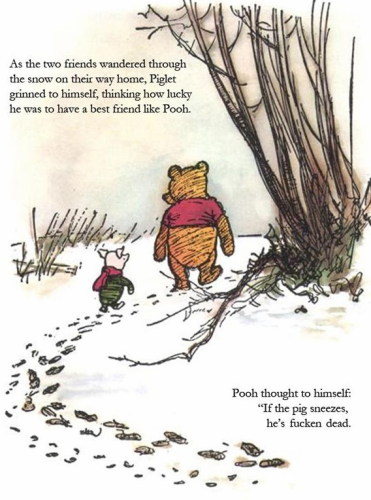
pooh-piglet-swine-flu
With apologies to the artist

Friday, July 31, 2009

Milton Weise 1932-2009

Yesterday morning I received the sad news that Milton Weise, a close friend in Kingston, Jamaica had died Monday when his car was in a collision. I did a quick search on the 'net and the only reference to the accident was on radiojamaica.com:

"Wednesday, 29 July 2009
The local business community is mourning the death of former Director of Cable and Wireless Jamaica Milton Weise. Mr. Weise, who was also the Chairman of National Environment Planning Agency and a consulting engineer, died on Monday night when the vehicle he was driving crashed in Cherry Gardens, St. Andrew."

This was Milton, as described in the discoverjamaica.com Personalities Directory:

"WEISE, Milton Ludlow, C. Eng., M.S.E., M.J.I.E., F.I.STruct. E., F.R.S.A., Dip. M.S.; Consulting Engineer. Principal and Chief Engineer Milton Weise & Associates, Consulting Engineers since 1963. Born: Kingston, Jamaica, April 17, 1932, son of the late Cladius M. Weise, Tailor, and Violet Shaw-Weise. Educated: Calabar Elementary School, Kingston Technical High School, South London Polytechnic. Career: Structural Designer Messrs. F. J. Samuely and Partners (London, England). Senior Engineer Messrs. Leonard & Grant (London, England), Deputy Chief Engineer Firth Cleveland Ltd. (Jamaica). Denomination: Baptist. Married: December 17, 1954 (divorced) ; 2 sons, 2 daughters. Interests: Tennis, Gardening. Club: Liguanea."

Milton Weise 1932-2009
Milton Weise, April 20, 1997
Kingston Harbour, Jamaica

I met Milton on July 2, 1988 when I went to Kingston, Jamaica for a three week stint teaching computer courses (DOS, WordPerfect, dBASE, Lotus 123) to engineers belonging to the Jamaica Institution of Engineers. Milton and I hit it off right from the get-go. After returning to Ottawa I kept in touch with a number of the engineers I had met that summer. When I returned to Jamaica with my wife, Helen, in October 1989 to celebrate our 25th Wedding Anniversary at the Liguanea Club in Kingston, Milton sponsored our stay there. And when we decided to take out a membership in the Club, Milton sponsored our membership request. From then until 2001 we normally connected with Milton at least twice a year when we would be in Kingston on holidays. Usually, on those 2 to 3 week excursions, we'd see Milton two, three or more times per week. Over the years we enjoyed spending many hours with Milton and Rosanne Lee, his long-time partner.

Unfortunately, family commitments have kept us from Jamaica for the last 8 years but we have continued to keep in contact with friends via email and telephone. We would usually visit with Milton by telephone once or twice a year. I last spoke with Milton a couple months ago. I had called using Skype-to-landline to see how he was doing following the death of Rosanne who had succumbed after a long battle with cancer. We must have chatted for about half an hour. Last week, I thought I should give him another call, but as usual I was just heading out somewhere when I thought of it and decided to wait until later. Now I'll never get to make that call.

I wonder how many time that sort of thing happens. You think of someone you should contact, but because you hesitate or postpone it you then never get the chance to have that talk. I think from now on, when I feel the urge to touch base with a friend I'll do it immediately just in case the chance slips away from me forever.

At least, that's the way I see it from Between Keyboard and Chair.

Wednesday, June 10, 2009

Children's Peace Plan - Evelyn Voigt

Today from Between Keyboard and Chair, I'm going to introduce you to one of my friends, Evelyn Voigt.

Evelyn happens to be my favourite Ottawa poet and a very dear friend. Evelyn was born a German prisoner of war in Norton, located close to Harare in what is now Zimbabwe. As a child she ran free on a farm in Tanzania, and later travelled widely. She chose Canada as her multi-cultural base; however, her work often takes her "home" to Africa. Evelyn has recorded a couple CDs of her poetry which are available via her web site.

Now some of you may think I'm a bit biased, and I agree I am, because Grateful We're Not Dead work with Evelyn quite frequently at peace related events. My all-time favourite poem of Evelyn's is The Children's Peace Plan and I always enjoy hearing her perform it. She did it recently at the Southminster United Church during the protest against the 2009 CANSEC Arms Show and it was caught on video. So for your listening pleasure and without further ado, here is Evelyn:


The Children's Peace Plan
(©Evelyn Voigt 2001)

Squeezing through a moon beam
she sat upon a star,
and looked down at the earth below
so very, very far.
She looked at all those children
Caught in the wars of man.
She heard their frightened voices
and came up with a plan.

In moments she was down there,
Whispering to each their name:

In China and in Germany,
in Azerbaijan and Spain;
In Russia and in Canada,
in Kenya and Peru;
Guyana and America,
Tibet and Timbuktu;
In Gaza and Jerusalem;
In Cairo and in Rome;
In Serbia and Croatia,
Burundi and at home.

The children's eyes grew wider,
as she told them of her plan.
Then solemnly they joined her.
Some walked. Some limped. Some ran.

She welcomed them with radiance.
She armed them with her smile.
She looked towards the cannons,
stacked mile, on mile, on mile.
She found herself a blossom,
a single blossom white,
Before she chose her cannon,
and sat on it, upright.

Above the cannon's mouth she sat,
Her smile as soft as dew;
And when the soldiers came to fire,
She said, "I welcome you".

And the children all took measure.
And the children chose their gun.
And the children smiled their magic smiles.
And the soldiers came undone.

They talked about their troubles.
They talked about their dreams.
The more they heard,
the more it seems:
Their problems weren’t that different.
Their hopes were much the same.
And, somehow, guns and warfare
seemed silly, tragic, lame.

Instead they chose to listen,
to plan, to heal, to please.
And the guns stood ever silent.
And the world was bathed in peace.

Squeezing through the moon beam,
she sat upon a star
and looked down at the earth below,
so very, very far.
She looked at all those children,
who sang and laughed and ran.
She thought about past battles,
and blessed her joyful plan.

So from Between Keyboard and Chair, I wish you peace.

Don

Monday, March 9, 2009

Win a Subscription to Linux Journal

Are you a Linux user? Are you considering migrating your computer(s) over to Linux? Are you going to set up a dual-boot system with Linux and that other OS? If so, you might want to consider a subscription to Linux Journal, one of the top resources for the Linux user. And if you feel lucky you can participate in the contest Linux Journal announced last Friday:

Houston, TX - March 5, 2009 - Linux Journal, the original magazine of the Linux community, announces a contest for viewers of LinuxJournal.com Tech Tip videos. During the week of March 9 - March 13, 2009 the daily Tech Tip videos will feature hosts Shawn Powers and Mitch Frazier announcing a few secret letters of the day. Viewers will need to collect the letters from each video that week (videos will be released daily) and come Friday March 13, unscramble the letters to reveal the secret word(s).

Contest rules: Participants must e-mail the correct secret word to contest@linuxjournal.com by 11:59:59PM U.S. Eastern Standard Time on Friday of March the 13th, 2009. In addition to the secret word participants must provide us with their full name, postal mailing address and e-mail address (none of which will be shared with anyone outside of Linux Journal at any time).

Prizes: Every participant who responds with the correct information by or before the 11:59:59PM U.S. Eastern Standard Time March, Friday 13th, 2009 deadline (03:59:59 GMT March 14, 2009) will receive a free 1 year digital subscription to Linux Journal -- one entry allowed per e-mail address. For those who already subscribe to Linux Journal, a free digital subscription will be appended to their current subscription.


You can check out the contest rules or if you feel lucky, just hop on over to this first article at Linux Journal and give it a whirl. Who knows, you may just be one of the winners of a free subscription to Linux Journal.

That's how I see it from Between Keyboard and Chair.

Don

Tuesday, December 16, 2008

Guest Commentary On The Auto Industry Bailout

Today, Between Keyboard and Chair is pleased to present a satirical commentary on the automobile industry bailout by guest 1st time blogger Aislyn Ireton, a student at Perth and District Collegiate Institute. Take it away, Aislyn.

Aislyn

As the North-American economy slowly slips into a recession, it is timely that the top three American auto makers would see fit to approach Congress to ask for funding to pay off debts and cover "operating" expenses. All three are asking for paltry amounts. GM needs US$12-billion, Ford is looking for US$9-billion, and Chrysler, who clearly are more thrifty, only requires US$7-billion. These economic woes snuck up on their accounting departments and became an immediate crisis so the money is needed sooner than later. More specifically, by December 31st, 2008.

Canada’s federal industry minister, Tony Clement and Ontario Premier, Dalton McGuinty, can expect to receive the companies’ requests for assistance that will be proportional to the assistance requested of the US government.

If our government should indeed come through with the money, there are some ways that the auto makers could thank the Canadian tax payers. Each Canadian household could receive a voucher via cheap, third class, bulk mail, a for a free vehicle of their choice from one the three main corporations.

I strongly agree with this reparation because it has many perks that will boost the Canadian confidence and economy.
  • If every Canadian was to drive a brand new vehicle of their choice there should be no problem with passing emissions tests. The government could save a lot of money by shutting down the branch of government responsible for monitoring emissions testing. This would free up some money to offset the funds that they will be giving to the auto makers from the public coffers.

  • Since there will be more cars on the road, more gas will be pumped at the stations and therefore the government’s tax share from the sale of fuel should increase dramatically.

  • As travel increases the need for more drive-ins and drive-thrus will increase. Heart clinics and Tim Horton will enjoy an increase in business. With sales at an all time high, surely the need for increased staff will follow and the unemployment rates should plummet.

  • Turmoil created by the OC Transpo strike will be demolished because citizens will all have cars to get themselves to the malls. The loss of green space that will be required to expand existing parking lots to accommodate all the cars is a small price to pay.

  • This is a time in our society where family life is busy and often chaotic. Being stuck in the endless lines of traffic and daily hold-ups as a result of all the extra cars on the road, will create opportunities for the family time that used to be spent around the dinner table.

  • Canadians will appear healthier than ever. Overwhelming amounts of CO² will be released, depleting the ozone layer and thus allowing UV rays to enter the atmosphere. We will all be sporting Coppertone tans and will easily absorb more than adequate amounts of the daily recommended levels of vitamin D.

  • One of the most pressing socio-economic issues in urban areas will be resolved. No one will be homeless.
So while we are all busy enjoying the euphoria caused by the "new car" smells, the top execs can be busy dipping into the Canadian government funding to offset their astronomically high annual bonuses and making unnecessary upgrades to their "one seater" private jets. With any money left over after these expenses, they can make a last ditch attempt at saving their plants.

Tuesday, November 25, 2008

I Was Tagged

On checking my private Plurks last week I found that Between Keyboard and Chair had been tagged by a Plurk friend, Rantz, in Australia. Now according to the rules of tagging, you have to do three things:
  1. Shout the tagger's blog
  2. Write 5 interesting facts about yourself
  3. Tag six more blogs
So the first task at hand is to shout Rantz's blog: rantz, the content of which he describes in the header as "blah blah blah blah blah blah blah blah blah blah blah blah blah blah blah blah blah blah blah blah blah blah blah". Actually, the blog covers a variety of topics and is worth dropping by for a read and a look at his pondcam.

Now to come up with five facts about myself. You'll have to decide if they're interesting.
  1. As anyone who reads this blog knows, I've met my wife 50 years ago and have been married to her for 44 years.

  2. I'm a Linux junkie and have been running openSUSE Linux almost exclusively on my 5 home systems since 2000. I keep Windows on a partition on one laptop in order to do my taxes each year.

  3. If you're familiar with the Grateful We're Not Dead blog here's another tidbit. After I finished playing in the Mississippi River Boys in 1985, I put my guitars away and didn't pick them up for another 13 years. In May, 1998 I started attending a monthly Music Night held at the home of Gord Breedyk and Evelyn Voigt. This was a sing-along event and I played guitar to accompany the singers. Common interests with Gord Breedyk and Bruce Penniston discovered at Music Night led to the formation of Grateful We're Not Dead.

  4. I started Carleton University in 1962, dropped out in 1964 and didn't complete my BSc in Chemistry until 1976.

  5. In July 1988 I took a contract in Kingston, Jamaica for 3 weeks to teach basic computer skills to Civil Engineers. I fell in love with the country and the people and from 1989 until 2001 my wife and I used to spend 3 to 4 weeks in Kingston, Jamaica each year on holiday.
And finally, the last task: tag six other blogs. Some of these may have already been tagged, but here goes in no particular order:So with this final task completed I'll go back to sleep until inspiration hits me with an idea for the next article. At least that's how I see it from Between Keyboard and Chair.

Saturday, November 8, 2008

60 Years In East Africa

60 Years in East Africa: Life of a Settler 1926 to 1986.

This book is the autobiography of Werner Voigt (1905 - 1997). It is written in a flowing conversational style and is an easy read.

Werner writes at the beginning of the book:
This story is written as I remember the different episodes; a bit embroidered, perhaps. I make no claims to the historical accuracy of my account. In many cases, the names have been changed.
As a young boy, Werner Voigt dreamed of reliving the adventures of Robinson Crusoe. In 1926, soon after completing a diploma in "Tropical and Subtropical Agriculture" at the German Colonial College he found himself on his way to Bagamoyo, Tanganyika (now Tanzania) in East Africa on a three year contract with a plantation. That three year contract turned into a sixty year affair with East Africa.
60years-150

On arriving in Africa, Werner worked as a plantation Manager, running and constructing plantations until the funds dried up during the Great Depression. Fortunately, he had saved sufficient money to purchase land at Mufindi in the southwestern highlands in the Iringa District. Through his story he shares the hardships, rewards, jubilation and disappointments he and his family experienced: the building of his first house; the arrival from Germany of Helga, his teenage bride-to-be; their 1000 Km honeymoon and gold prospecting trek; the disappointment of the coffee growing failure and the success of their Pyrethrum crop; the eight years of internment in British camps during the Second World War; starting from scratch again as "Tenants at Will" on what had been their own property prior to the War and having to accumulate sufficient funds to repurchase the property; the death of their eldest son, Werner; the success of their tea plantation; and finally, their decision to sell the farm and leave Tanzania in 1986.

Werner's autobiography is filled with many anecdotes containing interesting details about East Africa and the people he knew and loved.

Werner sums up his lifetime in East Africa as follows:
When I arrived in Bagamoyo in 1926, I was called "Bwana mdogo" (little Mister). Later, I was simply, "Bwana". When we got our own plantation, I became "Bwana mkubwa" (big Mister). When Tanzania became independent, we were all just simple "ndugu" (comrades). Later, I became the "Bwana mzee" (old Mister) and in the last years, I was called "Babu" (grandfather). These were the symbols of a lifetime in East Africa.
This book is an interesting read and reveals details of life over the decades in East Africa that you will not encounter in history books.

60 Years in East Africa is available from:

General Store Publishing House
499 O'Brien Rd
Box 415
Renfrew, Ontario K7V 4A6
1-800-465-6072

and can be ordered online as well.

A worthwhile read. At least that's how I see it from Between Keyboard and Chair.

Addendum (2008-11-10):
I am not the only one who found this to be a fascinating story. One of the author's daughters forwarded me reviews that appeared after the book was published in the mid 90s.
  • Betty Kilgour, Author and Columnist, A number of Betty Kilgour's books have been about her experiences in Africa
  • "On reading Werner Voigt's magnificent book, 60 Years in East Africa, I was blown away. I found myself embarked on such a magical journey of adventure, joy, sadness and love, I was unable to lay the book down.

    Told in a simple, direct, quietly elegant manner, it conveys not only the Voigt's amazing true story of their years in East Africa, but also the love and respect they feel for the African people.

    A book as grand as 60 Years in East Africa belongs in the company of such sweeping epics as ... Out of Africa - what a movie this book would make!"

  • Dave Brown, Columnist, The Ottawa Citizen. (comments in an Ottawa Citizen column about Werner and Helga Voigt)
  • "Like most uncommonly competent people, Werner Voigt saw disasters as minor setbacks. The solution to a failed crop was to try another crop. When locusts arrived by the millions, one avoided invitations to barbecues from staff members, who would be offering locusts as a delicacy. They replanted and started again."

  • Mora Johnson, Columnist, West End Flyer, Ottawa
  • "Sixty Years in East Africa is a fascinating autobiography of a person who has chosen an unusual and interesting life. I found the book difficult to put down."

  • DRB, Editor of Tanzania Affairs, Issued by the Britain-Tanzania Society, 1997
  • "This book is a rare gem ... this book is not to be missed ...

    It is the adventure-packed, gentle and moving personal story of the 60 years the author spent in Africa ...

    Do not start reading it when you are expecting visitors - you might resent the intrusion. Do not start reading it late at night (as I did) - you will miss a night's sleep! And watch out for the film that will surely follow."

Need A New Body Part? Just Grow It!

It appears that we're rapidly approaching medical procedures previously only encountered in science fiction. In April 2008 the US Defence Department announced the establishment of the Armed Forces Institute of Regenerative Medicine (AFIRM) and the US government budgeted $250 million of private and public money over 5 years . The key component of this Army-led collaborative initiative was to "harness stem cell research and technology in finding innovative ways to use a patient's natural cellular structure to reconstruct new skin, muscles and tendons, and even ears, noses and fingers".

Well things have progressed quickly, and as reported in the Ottawa Citizen via Canwest News Services:
American military researchers say they have unlocked the secret to regrowing limbs and recreating organs in humans who have sustained major injuries.

Using "nanoscaffolding", the researchers have regrown a man's fingertip and the internal organs of several test subjects.

The technology works by placing a very fine apparatus called a scaffold, which is made of polymer fibres hundreds of times finer than a human hair, in place of a missing limb or damaged organ. The scaffold acts as a guide for cells to grab onto so they can begin to rebuild missing bones and tissue. The tissue grows through tiny holes in the scaffold, in the same way a vine snakes its way up a trellis.

After the body part has regenerated, the scaffold breaks down, is absorbed into the person's body and disappears entirely.

The military plans to announce the breakthrough at the 26th Army Science Conference in Florida next month.
Previous research in England (2006) had shown that nanoscaffolding could be used to grow skin for grafting in severe burn cases. And in Australia in February, a PhD student released research papers showing how nanoscaffolding can be used to repair nerve damage.

The next question is, how soon will these types of procedures be readily available to the general public?

It never ceases to amaze me, the scientific advances I've seen over my 65 years and I expect to see many more before I shuffle off this mortal coil. At least, that's how I see it from Between Keyboard and Chair.

Tuesday, October 14, 2008

Bloggeries: Next Year's New Word In the English Language?

Bloggeries is a synonym for articles posted in a blog. Presumably, a bloggery would be a single blog article. The term is being promoted on the Bloggeries Blog forum. If the term is used frequently enough and starts to be used in written and oral communication without an explanation required as to its meaning then the chances of it being accepted into English dictionaries becomes very likely.

When Merriam-Webster released its list of new words for 2008, Peter Sokolowski, an editor-at-large for Merriam-Webster, was quoted in a San Francisco Chronicle article in July 7, 2008:
"As soon as we see the word used without explanation or translation or gloss, we consider it a naturalized citizen of the English language. If somebody is using it to convey a specific idea and that idea is successfully conveyed in that word, it's ready to go in the dictionary."
John Morse, Merriam-Webster's president and publisher, said the cleverness of many Web-related terms makes them easy to grasp and gives them staying power.
"There's a kind of collective genius on the part of the people developing this technology, using vocabulary that is immediately accessible to all of us. It's sometimes absolutely poetic."
So here's your chance to help promote a new word for the English language and to assist in getting it officially recognized. Start using the words bloggery and bloggeries to refer to blog postings. Use it in your written material and use it when you're speaking to people. With enough usage it will gain wide acceptance and you will have done your part in adding this term into the world's English vocabulary.

Anyway, that's how I see it from Between Keyboard and Chair.

Friday, October 10, 2008

How Queen Elizabeth Changed Our Wedding Date

On July 2, 1964 I proposed marriage to Helen Ireton of Drummond Center and the proposal was accepted. Helen worked at the Royal Bank in Perth, Ontario and I was working in the darkroom at Defence Research Board (DRB) in Ottawa. In August I started a full-time position with DRB at the princely salary of $3220/year. Our plan was to relocate to Ottawa after Helen received a transfer to the city. We decided that we would be married on Thanksgiving weekend: Saturday, October 10, 1964 at St. John's Anglican Church, Innisville. Planning for the wedding commenced. In those days it didn't take a year to plan a wedding. Helen's transfer was arranged very quickly and she was to start work at the Royal Bank, 90 Sparks Street, Ottawa on October 13. We located a new apartment in early September with occupancy on October 1. Seeing as I was in a new job I hadn't accumulated any leave credits so our honeymoon would consist of Sunday and Monday at our new apartment.

My father, Ed White, worked in Ottawa at Rideau Hall, the residence of the Governor-General, as a greenhouse man and floral designer. Shortly after planning for the wedding started he found out that the Queen and Prince Philip would be staying at Rideau Hall on Thanksgiving weekend and he would be required to work. What to do? We could either postpone the wedding or move it to Friday, October 9. Seeing as our only honeymoon would be a long weekend, we decided on Friday.

Now I've never been much of a church goer but Helen and I had to attend for three Sundays in September for the reading of the banns. It was a bit of a chuckle to hear ourselves referred to as Donald Edward White, bachelor and Helen Isobel Ireton, spinster. Once that was out of the way with no objections raised, everything was a go.

A week before the wedding, I requested the Friday off without pay. As soon as my manager found out I wanted the day off to get married, he readily agreed and then recommended that I be paid for the day as well.

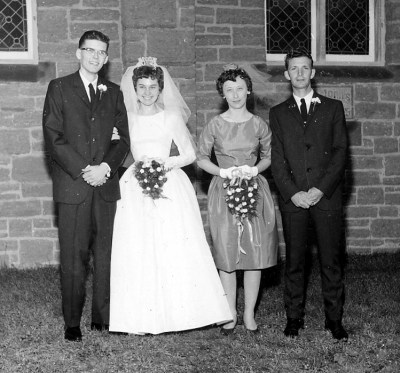
My father, being a floral designer, prepared all the flowers for the wedding. All the food for the reception was prepared at our parents and family friends. Helen's mother baked the wedding cake. A friend from my High School days, Bob Drader, agreed to photograph the wedding if I would return the favour when he was married. My long time friend and bass player for the Mississippi River Boys, Walter Cameron, was best man and his wife, Betty Cameron, matron-of-honour.

Bridal Party - 1964

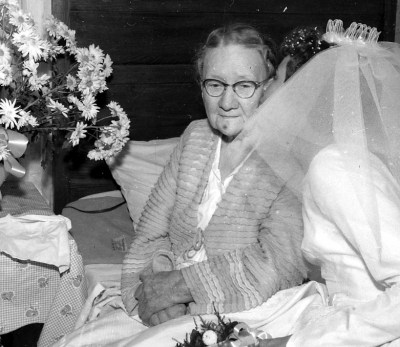
The guests at the wedding were all the aunts and uncles as well as a cousin of mine, Dave McCarthy, from Toronto whom I'd met while attending Carleton University. Following the wedding, the wedding dinner was held in the basement of the United Church in Boyd's Settlement and catered by the Anglican Church Womens' Guild. Following the dinner we visited with Helen's 84 year old grandmother in Scotch Corners who had been bed-ridden for four years. We then returned to the Ireton family farm for the remainder of the afternoon and early evening. Well the chores had to be done, eh! Cows to milk, pigs and chickens to feed, horses to care for.

Helen's Grandmother - 1964

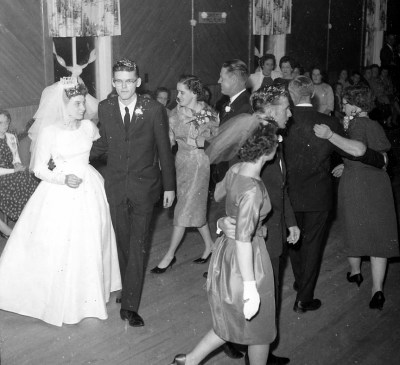
After the chores were completed we headed off to the hall in Ferguson Falls for a country-style wedding reception. Because I played with the Mississippi River Boys throughout the surrounding counties, the invitation to the wedding reception was open to anyone. Needless to say, the hall was swamped. The music for the reception was provided by a family friend, Milton Symington and his orchestra, from Arnprior. The first dance of the evening was a square dance, something that I'm sure you'd never see at a wedding now.

The First Dance - 1964

To make a long story short, this was the start to what has been an interesting, entertaining and loving 58 years. (Updated for October 9, 2022)

And as a final note, as I now repose Between Keyboard and Chair, I'd like to offer my thanks to Queen Elizabeth for her role in making our married life one day longer than we expected.