Tuesday, July 6, 2010

Plurk And Me

Back in September of 2008 I wrote a guest blog on a website that has since changed it's focus. After a bit of creative searching I managed to track down the article and have brought it home to Between Keyboard And Chair. So after some minor changes and with no further ado here is Plurk And Me

I assume if you’re reading this article you may already know about Plurk. If not, there are plenty of other articles online that will explain Plurk. As for the “me” in the title, I’m a 67 year old, retired Public Servant, Linux advocate, computer aficionado, avid Internet user, social networking junkie, photographer and musician (see Grateful We're Not Dead) - all of which I engage in with varying degrees of success. But the only thing I intend to talk about today is social networking: Plurk and me.
I originally became involved with computers in 1978 when I purchased a Commodore PET 2001. By the early 1980s I had my first exposure to what could be called “early social networking” via Bulletin Board Systems (BBS) and I actually ran a BBS out of my home for a number of years. By the early-90s Internet access had become available at home and I started using email and Internet Relay Chat (IRC) to communicate with people.
Then along came ICQ in the mid-90s and I started to connect with people world wide. I used various Instant Messaging Services until 2007 when I was introduced to the social networking / micro-blogging service, Twitter, during Ed Dale’s Thirty Day Challenge. I started using Twitter on a regular basis meeting more and more people around the globe. One of these, Allan Cockerill, a friend in Australia, introduced me to Plurk in June 2008.
Once I saw Plurk’s horizontal, scrollable timeline of time stamped messages (Plurks) along with the drop-down window containing all responses to the Plurk, I was hooked.
Plurk has become my main means of communicating within the social networking milieu mainly because of the ease with which I can track ongoing conversations (Plurks and responses). I quickly came to realize that Twitter was good for making announcement but Plurk had put the “social” back in social networking. I build my network of connections (friends) by checking the timelines of those who have responded to a Plurk, if I have not encountered them before. If the content of their timeline looks interesting I will either add them as a friend (once they have agreed to the request) or simply follow their Plurks. And in turn, I receive friendship requests from Plurkers who have come across me in a similar manner.
The one thing I find within Plurk is a sense of community that quickly builds up amongst the users. You can quickly become emotionally involved with the successes and failures, the joy and the sorrow of these on-line friends. If they disappear for a number of days you begin to worry about them and make inquiries of common friends. If they have a birthday, get a new job, have a baby, get married, etc., you celebrate with them. If they feel down you try to raise their spirits. As in any relationship, occasionally there are disagreements and arguments but as in most friendships these are usually resolved in an amicable manner.
As my group of friends has grown it has become virtually impossible to respond to every Plurk that appears on my timeline. However, there is a core group that I normally converse with, however briefly, each day. I then scan the timeline looking for interesting Plurks for which I may have a response. After that, I must confess, the remainder get MAAR’ed (Mark All As Read). But I do try to respond to every active friend at least once or twice a week.
Will I continue to use Plurk in the foreseeable future? I believe so, simply because of the emotional connections that have developed in this community of users. These are people I would miss if I didn’t hear from them occasionally. These “digital world” friends do not replace those in my “analogue world” but strongly supplement them.
I imagine I’ll continue to build my network of friends and acquaintances for quite awhile to come. And hopefully, if you’re interested, I’ll meet you in Plurk as well.
And if you want to link up with me on Plurk you'l find me at http://www.plurk.com/user/donwhite

Friday, June 25, 2010

You Can't Throw That Out!

Having lived in our home for almost 39 years, Helen and I have accumulated quite a bit of what would be considered by some to be junk. Now granted, it's all good junk but occasionally we get the urge to free up some space by passing on some of this excellent material to others. Of course, when that decision is made then comes the problem of deciding what we really, really need to keep and what we can gift to our friends, relatives, neighbours or whomever. Needless to say, as this task proceeds the keep pile always stays larger than the give pile.

However, the one area that is sacrosanct is Helen's stash. Anytime I look towards any of it, her immediate response is, "You can't throw that out!". Now when I was 40 years younger stash meant a whole different thing to me than it does now. Today's stash doesn't cause shivers down your back every time you see a police car cruise down the street. Of course, I'm talking about the fabric stash, that continually increasing collection of fabrics used for quilting. Helen is one of those quilters who keeps every little remnant of fabric just in case there might be a need for it. All of this material is stored in see-through plastic bins somewhat sorted by type of material and colour.

Part of the Stash

Now I thought it was getting a bit much awhile ago when I came across a bag of fabric scraps that were at least 40 years old. She said her mother had given them to her a few years ago and some of them were left-overs from quilts an aunt, long deceased, had made. My immediate response was, "What in Hell do you need 40 year old scraps for?". But being a well trained husband I didn't touch that bag.

Typical condition of frayed logs.

Well I've been put in my place. A few days ago, Helen started restoring a 50 year old Log Cabin quilt that belongs to one of her sisters. The quilt had been a gift from the same aunt whose scraps are in that bag in the basement. And guess what - some of that material is the same as was used in the quilt! So as part of the restoration, some of the original fabric will be used. A nice touch!

Original green fabric used in restoration.

So this old quilting-widower knows that when She Who Must Be Obeyed says, "You can't throw that out!", then I don't touch it no matter what it is, because her intuition is telling her that it will be needed in the future.

At least that's the way I see it from Between Keyboard and Chair.

Have a good one,

Don

Thursday, April 8, 2010

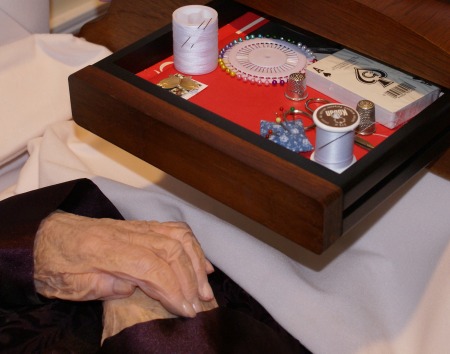
The Hands of the Quilter Stilled

I've been away from Between Keyboard and Chair for six months. It's amazing how time flies, even when you're not having fun.

My mother-in-law, Edna Gertrude Ireton (nee Gardiner) passed away on February 10, 2010 in her 93rd year. Edna had spent the last 15 years in a wheelchair as the result of a stroke which had left her paralyzed on the left side. Up until the Fall of 2008 when she moved to Lanark Lodge in Perth, Ontario she had lived in her own home near Drummond Centre with the assistance her son, Bob, who lived with her and home care workers who came to the house both morning and evening.

Edna was raised in the country, married in the country, raised her children (Helen, Allan, Bob, Barbara, Beverly, Dianne and John) in the country, lived her whole life in the country. In 2008, at the prompting of a daughter-in-law, she wrote some short notes concerning her life. I'd like to include a couple of them here.

First some comments concerning her youth:
"As a young girl I had a good sense of humour. Quiet. We didn't have much in the line of entertainment. We learned to play cards young. Sometimes some of us would gather at someone's house. If we were lucky we had live music, a violin, a tin whistle. We learned to dance. My father and two of my brothers were good step dancers.

I had three brothers older than myself, one sister younger. I never went to school after Grade 8. Back then it was Senior 4th Grade. My sister went to high school, then to business college. Got a job bookkeeping for a local business. I stayed at home, helped my mother. Money was scarce. You learned to save your pennies until you had enough to buy whatever you wanted or needed. You helped your neighbours when needed. Didn't always get paid. We didn't have the opportunities that the young people have today. I was 25 yrs old when I married in May 1942."
And what it was like being a farmer's wife:
"A typical day for me in my early married life would be to get up in early morning and help milk the cows by hand, feed calves and the hens or chickens before breakfast. There was a baby to look after, feed and dress. Washing to be done.

Had to have a noon meal ready the included potatoes and meat. Back then in the 1940s it was salt pork. It was stored in a salt brine in the basement. You had to dig a piece out, slice it by hand, parboil it in milk and water, then fry the slices. It tasted good enough. A lot of work. You had to have desert, pudding, pie or cake. Supper was much the same.

In the summer time there was always extra, the garden. Men had the crops and hay. Women were often called upon to help. It was busy and tiresome. Not much money. I guess when you're young you can handle these things better. It was the way of life."

Edna's passion was quilting and even after suffering her stroke and having the use of only one hand she continued to quilt with the help of two of her daughters, Helen and Barbara, and some of her quilting friends. All her children, grandchildren and some of her great-grandchildren received at least one of Edna's quilts during her lifetime.


Edna's Quilts - 1

Edna's Quilts - 2

Edna's Quilts - 4

Edna's Quilts - 3


Unfortunately, the hands of the quilter have now been stilled but her legacy will live on in her beautiful creations.

At least that's how I see it from Between Keyboard and Chair

Don

Wednesday, October 7, 2009

Natasha's Quilt

This article is long overdue for Between Keyboard and Chair. On July 1, 2009 Grateful We're Not Dead entertained at North Gower, Ontario for a fund raising BBQ in support of eye surgery for Natasha, a young lady who has been coming to Canada as part of the Ottawa Valley Aid for Chernobyl Children since she was 7 years old. Natasha has been slowly going blind and this year she came to Canada to have surgery on her eyes. You can read more about Natasha on the OVACC website.

After the band packed up on July 1st, Helen and I had the pleasure of meeting and talking with Natasha for a few minutes and discovered what a lovely young person she is. On the way home, Helen decided she would like to give one of her hand-made quilts to Natasha to take back to Belarus. So on August 7, following Natasha's eye surgery in Toronto, we delivered a lap-quilt to her at the farm of Burt and Nancy Grundy just outside of North Gower. Needless to say, Natasha was surprised and pleased to receive the quilt and informed us that blue was her favourite colour. We had an enjoyable visit with Natasha, Nancy and Burt and I grabbed a few quick shots of Natasha and her quilt before we returned to Ottawa.

Natasha and her Quilt
Natasha's Quilt

Label From Natasha's Quilt
Label on back of the quilt

Helen and Natasha
Helen and Natasha with the quilt

Prior to Natasha returning to Belarus, we received a very nice thank you card from her.

Thank You Card

Now this was the year that the Canadian Government (i.e. little Stevie Harper and the boys) refused to agree to new travel demands made by the Belarus government and it looked as if none of the children from Belarus would make it to Canada. However, a little Canadian ingenuity and determination goes a long way in bypassing the roadblocks thrown up by politicians and bureaucrats.

At least, that's how I see it from Between Keyboard and Chair.

Have a good one.

Don

Sunday, August 9, 2009

Get Yourself A Flu Buddy

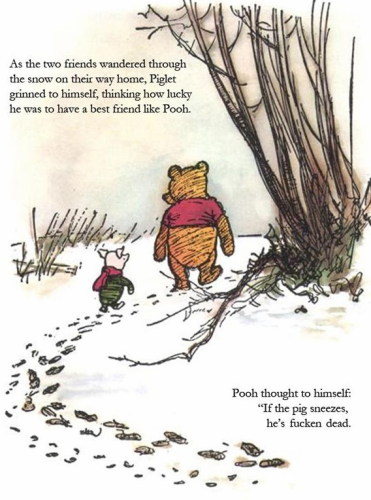
Between Keyboard and Chair sees that the public health system in Canada is recommending that you find yourself a flu buddy for the predicted onslaught of the H1N1 virus this Fall. They expect at least 50% of the population to contract Human Swine Flu. However, most people will not be sick enough to require hospitalization. In order to prevent overloading of hospital emergency rooms by people with non-life threatening symptoms during the expected pandemic they are suggesting that you team up with a flu buddy to look after you in the event you are "not well enough to go to the drugstore to buy some Tylenol".

Now is the time to make arrangements with family, friends and/or neighbours as to who will look after whom if that annoying little virus comes a-calling. Be prepared to help if you are the healthy one. Make arrangements to check with the elderly and those living by themselves on a regular basis if the flu strikes your neighbourhood. If you're heading out to shop, see if anyone needs you to pick up something.

Actually, there is nothing new in this approach. It's the way things used to be done before we became islands unto ourselves. When I was a youngster in the country, neighbours always helped neighbours. The hospital and the health system was the last line of defence and support. I think it's time to start using this approach again.

At least that's the way I see it from Between Keyboard and Chair.

Don
pooh-piglet-swine-flu
With apologies to the artist

Friday, July 31, 2009

Milton Weise 1932-2009

Yesterday morning I received the sad news that Milton Weise, a close friend in Kingston, Jamaica had died Monday when his car was in a collision. I did a quick search on the 'net and the only reference to the accident was on radiojamaica.com:

"Wednesday, 29 July 2009
The local business community is mourning the death of former Director of Cable and Wireless Jamaica Milton Weise. Mr. Weise, who was also the Chairman of National Environment Planning Agency and a consulting engineer, died on Monday night when the vehicle he was driving crashed in Cherry Gardens, St. Andrew."

This was Milton, as described in the discoverjamaica.com Personalities Directory:

"WEISE, Milton Ludlow, C. Eng., M.S.E., M.J.I.E., F.I.STruct. E., F.R.S.A., Dip. M.S.; Consulting Engineer. Principal and Chief Engineer Milton Weise & Associates, Consulting Engineers since 1963. Born: Kingston, Jamaica, April 17, 1932, son of the late Cladius M. Weise, Tailor, and Violet Shaw-Weise. Educated: Calabar Elementary School, Kingston Technical High School, South London Polytechnic. Career: Structural Designer Messrs. F. J. Samuely and Partners (London, England). Senior Engineer Messrs. Leonard & Grant (London, England), Deputy Chief Engineer Firth Cleveland Ltd. (Jamaica). Denomination: Baptist. Married: December 17, 1954 (divorced) ; 2 sons, 2 daughters. Interests: Tennis, Gardening. Club: Liguanea."

Milton Weise 1932-2009
Milton Weise, April 20, 1997
Kingston Harbour, Jamaica

I met Milton on July 2, 1988 when I went to Kingston, Jamaica for a three week stint teaching computer courses (DOS, WordPerfect, dBASE, Lotus 123) to engineers belonging to the Jamaica Institution of Engineers. Milton and I hit it off right from the get-go. After returning to Ottawa I kept in touch with a number of the engineers I had met that summer. When I returned to Jamaica with my wife, Helen, in October 1989 to celebrate our 25th Wedding Anniversary at the Liguanea Club in Kingston, Milton sponsored our stay there. And when we decided to take out a membership in the Club, Milton sponsored our membership request. From then until 2001 we normally connected with Milton at least twice a year when we would be in Kingston on holidays. Usually, on those 2 to 3 week excursions, we'd see Milton two, three or more times per week. Over the years we enjoyed spending many hours with Milton and Rosanne Lee, his long-time partner.

Unfortunately, family commitments have kept us from Jamaica for the last 8 years but we have continued to keep in contact with friends via email and telephone. We would usually visit with Milton by telephone once or twice a year. I last spoke with Milton a couple months ago. I had called using Skype-to-landline to see how he was doing following the death of Rosanne who had succumbed after a long battle with cancer. We must have chatted for about half an hour. Last week, I thought I should give him another call, but as usual I was just heading out somewhere when I thought of it and decided to wait until later. Now I'll never get to make that call.

I wonder how many time that sort of thing happens. You think of someone you should contact, but because you hesitate or postpone it you then never get the chance to have that talk. I think from now on, when I feel the urge to touch base with a friend I'll do it immediately just in case the chance slips away from me forever.

At least, that's the way I see it from Between Keyboard and Chair.

Tuesday, July 28, 2009

A Link To The Past

Years and years ago, it seems like half a century, I played in a country dance band called the Mississippi River Boys. We played the dance hall circuit throughout Lanark County as well as the surrounding counties. During the 1970s I penned a number of songs that we used by the band on a regular basis. We still include a couple of these in the Grateful We're Not Dead repertoire as well.

Yesterday I was cleaning out some boxes and came across a couple unlabelled cassette tapes. Out of curiosity I decide to see what was on them and too my surprise I came across one of the songs which I had recorded at home using multi-tracking and over-dubbing on a Dokorder 4-track open reel tape recorder. I guess I had mixed the tracks down to the cassette as a test mix. So I present here with all its glitches and warts, a link to my past. Any messups you hear are wholly attributable to me seeing as I played all parts - guitar, bass, harmonica, vocal, and backup vocal. Just click on the play button to hear it.


I hope that wasn't too painful.

Don

Wednesday, June 10, 2009

Children's Peace Plan - Evelyn Voigt

Today from Between Keyboard and Chair, I'm going to introduce you to one of my friends, Evelyn Voigt.

Evelyn happens to be my favourite Ottawa poet and a very dear friend. Evelyn was born a German prisoner of war in Norton, located close to Harare in what is now Zimbabwe. As a child she ran free on a farm in Tanzania, and later travelled widely. She chose Canada as her multi-cultural base; however, her work often takes her "home" to Africa. Evelyn has recorded a couple CDs of her poetry which are available via her web site.

Now some of you may think I'm a bit biased, and I agree I am, because Grateful We're Not Dead work with Evelyn quite frequently at peace related events. My all-time favourite poem of Evelyn's is The Children's Peace Plan and I always enjoy hearing her perform it. She did it recently at the Southminster United Church during the protest against the 2009 CANSEC Arms Show and it was caught on video. So for your listening pleasure and without further ado, here is Evelyn:


The Children's Peace Plan
(©Evelyn Voigt 2001)

Squeezing through a moon beam
she sat upon a star,
and looked down at the earth below
so very, very far.
She looked at all those children
Caught in the wars of man.
She heard their frightened voices
and came up with a plan.

In moments she was down there,
Whispering to each their name:

In China and in Germany,
in Azerbaijan and Spain;
In Russia and in Canada,
in Kenya and Peru;
Guyana and America,
Tibet and Timbuktu;
In Gaza and Jerusalem;
In Cairo and in Rome;
In Serbia and Croatia,
Burundi and at home.

The children's eyes grew wider,
as she told them of her plan.
Then solemnly they joined her.
Some walked. Some limped. Some ran.

She welcomed them with radiance.
She armed them with her smile.
She looked towards the cannons,
stacked mile, on mile, on mile.
She found herself a blossom,
a single blossom white,
Before she chose her cannon,
and sat on it, upright.

Above the cannon's mouth she sat,
Her smile as soft as dew;
And when the soldiers came to fire,
She said, "I welcome you".

And the children all took measure.
And the children chose their gun.
And the children smiled their magic smiles.
And the soldiers came undone.

They talked about their troubles.
They talked about their dreams.
The more they heard,
the more it seems:
Their problems weren’t that different.
Their hopes were much the same.
And, somehow, guns and warfare
seemed silly, tragic, lame.

Instead they chose to listen,
to plan, to heal, to please.
And the guns stood ever silent.
And the world was bathed in peace.

Squeezing through the moon beam,
she sat upon a star
and looked down at the earth below,
so very, very far.
She looked at all those children,
who sang and laughed and ran.
She thought about past battles,
and blessed her joyful plan.

So from Between Keyboard and Chair, I wish you peace.

Don

Monday, March 9, 2009

Win a Subscription to Linux Journal

Are you a Linux user? Are you considering migrating your computer(s) over to Linux? Are you going to set up a dual-boot system with Linux and that other OS? If so, you might want to consider a subscription to Linux Journal, one of the top resources for the Linux user. And if you feel lucky you can participate in the contest Linux Journal announced last Friday:

Houston, TX - March 5, 2009 - Linux Journal, the original magazine of the Linux community, announces a contest for viewers of LinuxJournal.com Tech Tip videos. During the week of March 9 - March 13, 2009 the daily Tech Tip videos will feature hosts Shawn Powers and Mitch Frazier announcing a few secret letters of the day. Viewers will need to collect the letters from each video that week (videos will be released daily) and come Friday March 13, unscramble the letters to reveal the secret word(s).

Contest rules: Participants must e-mail the correct secret word to contest@linuxjournal.com by 11:59:59PM U.S. Eastern Standard Time on Friday of March the 13th, 2009. In addition to the secret word participants must provide us with their full name, postal mailing address and e-mail address (none of which will be shared with anyone outside of Linux Journal at any time).

Prizes: Every participant who responds with the correct information by or before the 11:59:59PM U.S. Eastern Standard Time March, Friday 13th, 2009 deadline (03:59:59 GMT March 14, 2009) will receive a free 1 year digital subscription to Linux Journal -- one entry allowed per e-mail address. For those who already subscribe to Linux Journal, a free digital subscription will be appended to their current subscription.


You can check out the contest rules or if you feel lucky, just hop on over to this first article at Linux Journal and give it a whirl. Who knows, you may just be one of the winners of a free subscription to Linux Journal.

That's how I see it from Between Keyboard and Chair.

Don

Tuesday, December 16, 2008

Guest Commentary On The Auto Industry Bailout

Today, Between Keyboard and Chair is pleased to present a satirical commentary on the automobile industry bailout by guest 1st time blogger Aislyn Ireton, a student at Perth and District Collegiate Institute. Take it away, Aislyn.

Aislyn

As the North-American economy slowly slips into a recession, it is timely that the top three American auto makers would see fit to approach Congress to ask for funding to pay off debts and cover "operating" expenses. All three are asking for paltry amounts. GM needs US$12-billion, Ford is looking for US$9-billion, and Chrysler, who clearly are more thrifty, only requires US$7-billion. These economic woes snuck up on their accounting departments and became an immediate crisis so the money is needed sooner than later. More specifically, by December 31st, 2008.

Canada’s federal industry minister, Tony Clement and Ontario Premier, Dalton McGuinty, can expect to receive the companies’ requests for assistance that will be proportional to the assistance requested of the US government.

If our government should indeed come through with the money, there are some ways that the auto makers could thank the Canadian tax payers. Each Canadian household could receive a voucher via cheap, third class, bulk mail, a for a free vehicle of their choice from one the three main corporations.

I strongly agree with this reparation because it has many perks that will boost the Canadian confidence and economy.
  • If every Canadian was to drive a brand new vehicle of their choice there should be no problem with passing emissions tests. The government could save a lot of money by shutting down the branch of government responsible for monitoring emissions testing. This would free up some money to offset the funds that they will be giving to the auto makers from the public coffers.

  • Since there will be more cars on the road, more gas will be pumped at the stations and therefore the government’s tax share from the sale of fuel should increase dramatically.

  • As travel increases the need for more drive-ins and drive-thrus will increase. Heart clinics and Tim Horton will enjoy an increase in business. With sales at an all time high, surely the need for increased staff will follow and the unemployment rates should plummet.

  • Turmoil created by the OC Transpo strike will be demolished because citizens will all have cars to get themselves to the malls. The loss of green space that will be required to expand existing parking lots to accommodate all the cars is a small price to pay.

  • This is a time in our society where family life is busy and often chaotic. Being stuck in the endless lines of traffic and daily hold-ups as a result of all the extra cars on the road, will create opportunities for the family time that used to be spent around the dinner table.

  • Canadians will appear healthier than ever. Overwhelming amounts of CO² will be released, depleting the ozone layer and thus allowing UV rays to enter the atmosphere. We will all be sporting Coppertone tans and will easily absorb more than adequate amounts of the daily recommended levels of vitamin D.

  • One of the most pressing socio-economic issues in urban areas will be resolved. No one will be homeless.
So while we are all busy enjoying the euphoria caused by the "new car" smells, the top execs can be busy dipping into the Canadian government funding to offset their astronomically high annual bonuses and making unnecessary upgrades to their "one seater" private jets. With any money left over after these expenses, they can make a last ditch attempt at saving their plants.