Showing posts with label quilting. Show all posts

Sunday, January 12, 2014

A Quilt Story

My wife, Helen, has become an avid quilter since making her first quilt back in 2008. Prior to that she had helped her mother, Edna Ireton, with her quilting. Edna was restricted to a wheelchair for the last 15 years of her life as the result of a stoke which left her paralyzed on the left side so Helen and her sister, Barbara, would assist with the cutting and assembling. The Hands of the Quilter Stilled

Helen is an excellent seamstress and is frequently called upon by family members and friends to alter or repair garments. She also has over the past few years also been asked to refurbish old quilts. You Can't Throw That Out!

Following Edna's death, her quilts were being passed on to family members and her granddaughter, Hilary, just loved one old quilt. The quilt was quite tattered and worn around the edges because of the use it had gotten over the decades. Hilary approached her Aunt Helen to see if the quilt could be repaired and, as usual, Helen agreed to see what she could do with it to make it usable again.


Helen refurbished the quilt and attached the the following story for Hilary to the back so it wouldn't be lost.


A Treasure In Grandma Ireton's Cedar Chest
Flower Basket Quilt Story
Every quilt has a story and this is the story of the Flower Basket Quilt, and the surprise it delivered over seventy years later to Hilary Ireton, grand-daughter of Grandma Edna Gertrude Ireton (nee Gardiner).

This quilt was created by Grandma Ireton and you can be sure a lot of love went into each stitch. Grandma was happiest when creating something beautiful with her hands.

Grandma Ireton would have made this quilt in the late 1930's. Great Grandma Mary Ellen Gardiner (nee Dowdall) would have, no doubt, helped Grandma cut the fabric into the pieces needed to complete the quilt top. The old fashioned prints used would probably be from shirts, aprons and curtains as well as flour sacks washed and bleached until the sacks were as white as snow. Grandma sewed the pieces of fabric together using a treadle sewing machine, using her feet to manipulate the machine treadle by pushing with her toes and heels in an even manner to create a smooth stitch line.

All quilts have three layers: the top fabric or quilt top, the batting layer, and the backing material. Grandma and Great Grandma hand quilted all three layers of the entire quilt using wooden hand quilting frames which made it easy to keep all three layers tight and together while hand quilting.

When the quilt was completed it was placed in Grandma's cedar chest only to be used after she was married. Grandpa and Grandma were married on May 20, 1942. Grandpa and Grandma lived on the family farm at Drummond Centre. The farm has been in the Ireton family name since April 1, 1896.

Grandma Ireton died on February 10, 2010, at the age 93 years. Much to Hilary's surprise Grandma's beautiful Flower Basket Quilt was passed down to Hilary to be used on her bed.

Grandma used the Flower Basket quilt for many years on their bed. In October 2012, Aunt Helen White (nee Ireton) refurbished the quilt replacing the original binding with new fabric to return the quilt to a usable state.

Hilary, when you sleep under Grandma's Flower Basket Quilt, you sleep under a blanket of love.


Good Night, Sweet Dreams


See you again soon from Between Keyboard and Chair

Don

Friday, June 25, 2010

You Can't Throw That Out!

Having lived in our home for almost 39 years, Helen and I have accumulated quite a bit of what would be considered by some to be junk. Now granted, it's all good junk but occasionally we get the urge to free up some space by passing on some of this excellent material to others. Of course, when that decision is made then comes the problem of deciding what we really, really need to keep and what we can gift to our friends, relatives, neighbours or whomever. Needless to say, as this task proceeds the keep pile always stays larger than the give pile.

However, the one area that is sacrosanct is Helen's stash. Anytime I look towards any of it, her immediate response is, "You can't throw that out!". Now when I was 40 years younger stash meant a whole different thing to me than it does now. Today's stash doesn't cause shivers down your back every time you see a police car cruise down the street. Of course, I'm talking about the fabric stash, that continually increasing collection of fabrics used for quilting. Helen is one of those quilters who keeps every little remnant of fabric just in case there might be a need for it. All of this material is stored in see-through plastic bins somewhat sorted by type of material and colour.

Part of the Stash

Now I thought it was getting a bit much awhile ago when I came across a bag of fabric scraps that were at least 40 years old. She said her mother had given them to her a few years ago and some of them were left-overs from quilts an aunt, long deceased, had made. My immediate response was, "What in Hell do you need 40 year old scraps for?". But being a well trained husband I didn't touch that bag.

Typical condition of frayed logs.

Well I've been put in my place. A few days ago, Helen started restoring a 50 year old Log Cabin quilt that belongs to one of her sisters. The quilt had been a gift from the same aunt whose scraps are in that bag in the basement. And guess what - some of that material is the same as was used in the quilt! So as part of the restoration, some of the original fabric will be used. A nice touch!

Original green fabric used in restoration.

So this old quilting-widower knows that when She Who Must Be Obeyed says, "You can't throw that out!", then I don't touch it no matter what it is, because her intuition is telling her that it will be needed in the future.

At least that's the way I see it from Between Keyboard and Chair.

Have a good one,

Don

Thursday, April 8, 2010

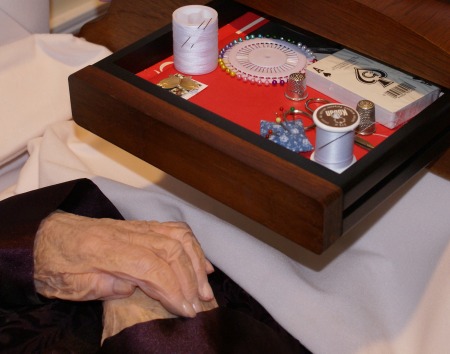
The Hands of the Quilter Stilled

I've been away from Between Keyboard and Chair for six months. It's amazing how time flies, even when you're not having fun.

My mother-in-law, Edna Gertrude Ireton (nee Gardiner) passed away on February 10, 2010 in her 93rd year. Edna had spent the last 15 years in a wheelchair as the result of a stroke which had left her paralyzed on the left side. Up until the Fall of 2008 when she moved to Lanark Lodge in Perth, Ontario she had lived in her own home near Drummond Centre with the assistance her son, Bob, who lived with her and home care workers who came to the house both morning and evening.

Edna was raised in the country, married in the country, raised her children (Helen, Allan, Bob, Barbara, Beverly, Dianne and John) in the country, lived her whole life in the country. In 2008, at the prompting of a daughter-in-law, she wrote some short notes concerning her life. I'd like to include a couple of them here.

First some comments concerning her youth:
"As a young girl I had a good sense of humour. Quiet. We didn't have much in the line of entertainment. We learned to play cards young. Sometimes some of us would gather at someone's house. If we were lucky we had live music, a violin, a tin whistle. We learned to dance. My father and two of my brothers were good step dancers.

I had three brothers older than myself, one sister younger. I never went to school after Grade 8. Back then it was Senior 4th Grade. My sister went to high school, then to business college. Got a job bookkeeping for a local business. I stayed at home, helped my mother. Money was scarce. You learned to save your pennies until you had enough to buy whatever you wanted or needed. You helped your neighbours when needed. Didn't always get paid. We didn't have the opportunities that the young people have today. I was 25 yrs old when I married in May 1942."
And what it was like being a farmer's wife:
"A typical day for me in my early married life would be to get up in early morning and help milk the cows by hand, feed calves and the hens or chickens before breakfast. There was a baby to look after, feed and dress. Washing to be done.

Had to have a noon meal ready the included potatoes and meat. Back then in the 1940s it was salt pork. It was stored in a salt brine in the basement. You had to dig a piece out, slice it by hand, parboil it in milk and water, then fry the slices. It tasted good enough. A lot of work. You had to have desert, pudding, pie or cake. Supper was much the same.

In the summer time there was always extra, the garden. Men had the crops and hay. Women were often called upon to help. It was busy and tiresome. Not much money. I guess when you're young you can handle these things better. It was the way of life."

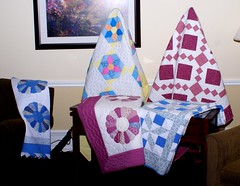
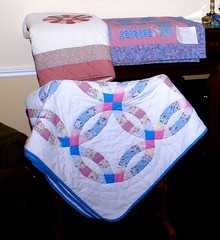
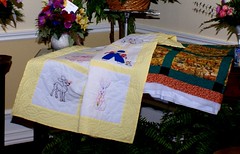
Edna's passion was quilting and even after suffering her stroke and having the use of only one hand she continued to quilt with the help of two of her daughters, Helen and Barbara, and some of her quilting friends. All her children, grandchildren and some of her great-grandchildren received at least one of Edna's quilts during her lifetime.


Edna's Quilts - 1

Edna's Quilts - 2

Edna's Quilts - 4

Edna's Quilts - 3


Unfortunately, the hands of the quilter have now been stilled but her legacy will live on in her beautiful creations.

At least that's how I see it from Between Keyboard and Chair

Don